Directed by Joe Dante, Piranha follows Insurance investigator Maggie McKeown (Heather Menzies) who is dispatched to find two teenagers who have gone missing near Lost River Lake. After hiring the surly drunkard Paul Grogan (Bradford Dillman) to serve as her guide and help her search the area, they find a seemingly abandoned military facility. The two end up draining one of the facility's pools and accidentally releasing a particularly vicious swarm of piranha into the local waterways. Maggie and Paul race to warn the locals, but their pleas fall upon skeptical ears - until the piranha reach the swimmers.
Piranha is a spoof of "Nature Run Amok" films, with Jaws being the specific target. The movie is incredibly goofy at times, having characters act in ways that seem rather illogical and utilizing some cheesy special effects for the titular creatures. However, none of these elements actually hurt the film, but help make the film incredibly enjoyable to watch.
Piranha is a film that knows exactly what it is, a cheesy spoof of a popular film that doesn't take itself seriously in the slightest. If you can accept that, you will find a lot to like about the film. Dillman and Menzies actually give decent performances, presenting their somewhat eccentric characters in a believable and likable manner. While a good amount of the effects are rather cheesy, there are a few that I found pretty well executed, such as the stop-motion creatures lurking within abandoned military facility. The music is also not half bad and there are a few moments in the film that are actually rather scary and well-done (like the piranha attack at the summer camp)
Piranha is one of those films that can be pretty entertaining if you accept the inherent goofiness of the product. It's not a masterpiece of horror cinema, but its still an enjoyable film that I'd recommend to those who like goofy monster films and Joe Dante movies.
Showing posts with label Netflix. Show all posts
Wednesday, October 9, 2013
Tuesday, October 8, 2013
31 Days of Horror: The Howling: Reborn (2011)
A few years ago, I watched The Howling for the first time. I've always been a werewolf fan and I felt I had to watch the classics, such as The Wolf-Man and An American Werewolf in London. I immediately fell in love with the film and its one of my favorite monster movies of all time. With that piece of context, you can understand what I mean when I say that The Howling: Reborn is one of the most depressing and disappointing films that I've seen in a very long time.
It's rather obvious that The Howling: Reborn is trying desperately to draw in the Twilight crowd. Both films share a rather gloomy soundtrack, washed-out cinematography, and pretentious philosophizing that makes you want to just punch whoever is saying this stupid shit. The story, like the sanitized supernatural romances that its trying to emulate, is rather dull and predictable, hitting all the expected beats.
The special effects are just as bad. Some, like the oddly psychopathic bully falling over the stair railing, are so bad they managed to coax a laugh out of me. The rest just made sigh and wish I was watching the original. Its kind of sad seeing how far this franchise has fallen.
Now, I will give the film this, the majority of the actors seem to actually be trying to take the mediocre script and give a decent performance. The two leads, Landon Liboiron and Lindsay Shaw, being the most successful. The two actors do seem to have some inkling of chemistry, which is more than I can say for their Twilight counterparts.
However, their performances are not enough to save this incredibly mediocre film. Its boring, uninspired, and rather depressing if you're a fan of the original. If you're looking for a good werewolf film, watch the 1st Howling and An American Werewolf in London instead.
Verdict: See it if you like the Twilight formula and like the two leads starts a lot. Skip it if you like your werewolf films to be a little more brutal and not so sanitized.
Wednesday, October 2, 2013
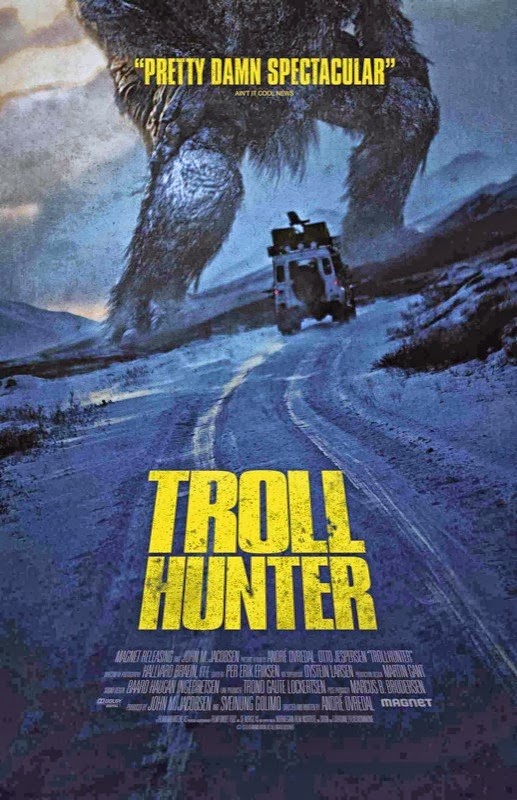
31 Days of Horror: Trollhunter (2010)
Director: André Øvredal
Writer: André Øvredal
Starring: Otto Jespersen, Hans Morten Hansen, Tomas Alf Larsen, Johanna Mørck, Knut Nærum, Robert Stoltenberg, Glenn Erland Tosterud
Summary: Trollhunter follows a group of Norwegian film students who are shadowing Hans, a professional hunter who tracks down and eliminates real-life trolls for the government agency known as the Troll Security Service, who do everything they can to keep the public ignorant of the troll menace.
The Good: As I've mentioned before, I am really not a fan of the "found footage" genre. Like 3-D, I see "found footage" as a gimmick that filmmakers use to make something seem more "real" when the actual style adds very little to the film. Thankfully, Trollhunter's director knows how to use the vérité and uses it well. Like The Bay, Trollhunter is shot as if its a documentary, which gives a ready explanation for the camera's presence. Also, since the documentary crew is supposed to be a couple of college students who have never made a documentary before, the questionable cinematography can be forgiven.
The basic concept that acts as the foundation of the film is really interesting. While its not a very original premise, its still fun to see what it would be like if trolls actually existed. Being someone who loves folklore and mythology, it was cool to see the trolls retain their weakness to sunlight, their rock-based appetite, and the ability to smell the blood of a Christian. Its also interesting to learn how the trollhunter Hans hunts these creatures and learn how the Troll Security Service (TSS for short) keeps their existence a secret. After watching the film, I want to know more about these trolls, the TSS, and if similar organizations and other trollhunters exist around the world.
Speaking of trollhunters, the character of Hans is rather intriguing as well. The character comes off as a weary warrior who is growing tired of the fight and sees the chance to finally come clean about the secrets he's been keeping when these college students who up, wanting to film him. Otter Jespersen plays the character perfectly, the tired nature of the character coming through clearly thanks to Jespersen's performance and posture throughout the film. He is easily the best thing in this film.
The Bad: While this is probably the result of a low budget, the CGI effects in the film are rather poor. They aren't horrible and they get the job done, but I always felt myself draw out of the film almost every time one of the trolls was on screen. The only exception was the Jotnar at the end of the film, which was pretty well done.
Besides Hans, the other characters in the film are rather bland or one-note. When Hans wasn't the focus of the film, I found myself not really caring about any of the other characters and just wanting to get back to Hans and his situation.
Conclusion: While the CGI is rather lackluster and most of the characters are rather bland, Trollhunters is saved by an interesting concept, good execution, and a very interesting main character. If you like monster movies and want to see one with an interesting take on the situation, give Trollhunter a watch.
Writer: André Øvredal
Starring: Otto Jespersen, Hans Morten Hansen, Tomas Alf Larsen, Johanna Mørck, Knut Nærum, Robert Stoltenberg, Glenn Erland Tosterud
Summary: Trollhunter follows a group of Norwegian film students who are shadowing Hans, a professional hunter who tracks down and eliminates real-life trolls for the government agency known as the Troll Security Service, who do everything they can to keep the public ignorant of the troll menace.
The Good: As I've mentioned before, I am really not a fan of the "found footage" genre. Like 3-D, I see "found footage" as a gimmick that filmmakers use to make something seem more "real" when the actual style adds very little to the film. Thankfully, Trollhunter's director knows how to use the vérité and uses it well. Like The Bay, Trollhunter is shot as if its a documentary, which gives a ready explanation for the camera's presence. Also, since the documentary crew is supposed to be a couple of college students who have never made a documentary before, the questionable cinematography can be forgiven.
The basic concept that acts as the foundation of the film is really interesting. While its not a very original premise, its still fun to see what it would be like if trolls actually existed. Being someone who loves folklore and mythology, it was cool to see the trolls retain their weakness to sunlight, their rock-based appetite, and the ability to smell the blood of a Christian. Its also interesting to learn how the trollhunter Hans hunts these creatures and learn how the Troll Security Service (TSS for short) keeps their existence a secret. After watching the film, I want to know more about these trolls, the TSS, and if similar organizations and other trollhunters exist around the world.
Speaking of trollhunters, the character of Hans is rather intriguing as well. The character comes off as a weary warrior who is growing tired of the fight and sees the chance to finally come clean about the secrets he's been keeping when these college students who up, wanting to film him. Otter Jespersen plays the character perfectly, the tired nature of the character coming through clearly thanks to Jespersen's performance and posture throughout the film. He is easily the best thing in this film.
The Bad: While this is probably the result of a low budget, the CGI effects in the film are rather poor. They aren't horrible and they get the job done, but I always felt myself draw out of the film almost every time one of the trolls was on screen. The only exception was the Jotnar at the end of the film, which was pretty well done.
Besides Hans, the other characters in the film are rather bland or one-note. When Hans wasn't the focus of the film, I found myself not really caring about any of the other characters and just wanting to get back to Hans and his situation.
Conclusion: While the CGI is rather lackluster and most of the characters are rather bland, Trollhunters is saved by an interesting concept, good execution, and a very interesting main character. If you like monster movies and want to see one with an interesting take on the situation, give Trollhunter a watch.
Tuesday, October 1, 2013
31 Days of Horror: The Bay (2012)
Director: Barry Levinson
Writer: Michael Wallach
Starring: Kether Donohue, Kristen Connolly, Anthony Reynolds, Michael Beasley, Jane McNeil, Stephen Kunken
Summary: On July 4, 2009, a deadly menace swept through the quaint seaside town of Claridge, Maryland. The authorities believed they had buried the truth about the tragedy. Now, three years later, a reporter who survived the horrors of that terrible day has emerged with footage revealing the cover-up and what actually happened.
The Good: Generally, I’m not the biggest fan of “found footage” movies. Usually, I find the style unnecessary because the majority of films that seem to use it have stories that could easily be told with a more traditional narrative and the found footage style adds nothing to the story.
Thankfully, The Bay manages to dodge both of those complaints. The film is told in an amateur, documentary style where our narrator has collected footage of the event through a government leak and has put it together to tell a tale of the Claridge Tragedy in a cohesive fashion. While I could see a few ways they could have told the story in a more traditional narrative, I believe the spliced-together, documentary style they chose to use fits the story better.
The acting in the film is pretty decent as well. While there are a small handful of background actors and actresses that give somewhat weak performances, the main actors give believable performances with Kristen Connolly as the young mother Stephanie and Stephen Kunken as Dr. Abram being the best of the group.
Director Barry Levinson and writer Michael Wallach also demonstrate the proper way to make a horror film. Instead of just throwing stuff at the camera and making the occasional loud noise, they choose to build the tension slowly and bring out the scares at just the right time. Also, the film focuses more on the terror of the situation, which I think was a good choice based on the story and the way they are telling it.
Finally, the majority of the special effects in the movie were very well done for the film’s budget. Most of the effects seemed to be practically done, and that’s always a good thing in my book. The CGI effects were a little sketchy, but they never lingered on them for long, using the found footage style to their advantage and hiding the short-coming.
The Bad: Like most found footage films, The Bay's cinematography is somewhat questionable. While it is nowhere near the worst cinematography I've seen for one of these kinds of films and the footage is supposed to be somewhat amateurishly done, it still got on my nerves at times.
Also, there are times when the film is showing different camera angles that are rather weird when you realize no one would have been able to get these shots because of the situation going on at the moment. Also, there are times in the movie that caused me to wonder why a character was still carrying the camera when someone else would have put it down. While this is a common thing in found footage films, it is still annoying.
Conclusions: While there are some cinematography problems with the film, The Bay is still one of the better found footage films I’ve seen in awhile. If you like the found footage sub-genre, like horror films that build up tension and dread, and deal with government cover-ups and ecological terror, you will enjoy The Bay.
Wednesday, July 31, 2013
Netflix Reviews: The ABCs of Death
Directed By: Nacho Vigalondo, Ti West, Adam Wingard, Srdjan Spasojevic, Ben Wheatly, Jon Schnepp, Xavier Gens, Jason Eisener, Yoshihiro Nishimura, etc.
Written By: Nacho Vigalondo, Ti West, Adam Wingard, Srdjan Spasojevic, Ben Wheatly, Jon Schnepp, Xavier Gens, Jason Eisener, Yoshihiro Nishimura, etc.
Main Cast: Dallas Malloy, Peter Pedrero, Fraser Corbett, Kyra Zagorsky, Darenzia, etc.
Summary: The ABCs of Death is an anthology film divided into 26 individual chapters, each handled by a different director assigned a different letter of the alphabet. Each director was given free rein to choose a word to create a story involving death, which range from accidents to murder.
The Good: Its kind of hard to review a film like The ABCs of Death. Not only is it an anthology film, but its an anthology film where each short is made by a different director and creative team and there are 26 of them. So, to make this easier on everyone reading, I'm just going to touch on the shorts I particularly liked and disliked.
G is for Gravity (directed and written by Andrew Traucki): This was the first short in the film that I actually liked. It was rather simple, short, and made good use of the letter G. While I'm not a big fan of the shaky cam, I can forgive it for this short since its supposed to be a first person perspective. I also loved how the short managed to convey its story without a single line of dialogue. The behavior and the heavy breathing of the POV character helped as well.
H is for Hydro-Electric Diffusion (directed and written by Thomas Malling): Malling's short was definitely one of the more comedic ones and one of the few of that variety that I actually felt worked. The short is just so weird, but you can feel the hard work the director and crew put into it and its easily one of the most fun. Also, the costuming, make-up, and set design was fantastic.
Q is for Quack (directed and written by Adam Wingard and Simon Barrett): Q is for Quack is another one of the "comedy" shorts that really works. I love the meta-fictional concept of the directors struggling to find a word and hook for the letter Q. The acting on this one is really solid as well, Wingard and Barret feeling very natural and believable as themselves. To be honest, this was probably my favorite short in the film.
U is for Unearthed (directed and written by Ben Wheatley): Another short shot with a first-person perspective, U is for Unearthed is a very quick and interesting little chapter. The film is shown from the perspective of a recently risen vampire who is chased by an angry mob that is trying to kill him. I think I liked this one mostly because it kept closer to vampiric mythology and kept the vampire as a soulless monster.
The Bad: Now, like most anthology films, The ABCs of Death is very uneven. While some of the shorts are really good and a lot of them are decent, there are some that are just god awful. Here's the ones that I personally found rather dreadful.
D is for Dogfight (directed and written by Marcel Sarmiento): While the cinematography is amazing and the use of slow-motion throughout the short is very effective, the are some big problems with the plot that when you start to think about them, make the story kind of fall apart.
F is for Fart (directed and written by Noboru Iguchi): This one was by far the dumbest short of the bunch. The story revolves around a Japanese school girl who decided she'd rather be killed by the teacher who she has a crush on's farts instead of a poisonous gas released by an earthquake. The special effects are horrible, the story is mind-numbingly dumb, and just had me shaking my head by the end of it.
M is for Miscarriage (directed and written by Ti West): This one was really disappointing because I usually like West's work. I loved House of the Devil and I thought The Innkeepers was fantastic. However, M is for Miscarriage is just really lazily done and rather mean-spirited. The only good thing about this chapter is that it is incredibly short.
O is for Orgasm (directed and written by Bruno Forzani & Helene Cattet): While I hate to use this word because it is incredibly overused, but its best word to use when critiquing this chapter. O is for Orgasm is just a collection of "artsy", pretentious images strung together. Luckily, like M is for Miscarriage, this one goes by rather quickly.
W is for WTF! (directed and written by Jon Schnepp): Like M is for Miscarriage, W is for WTF! is incredibly lazy and tries to steal the basic concept behind Q is for Quack. While the random nature of the short does match the chosen word pretty well, the random scenes aren't particularly good and are downright annoying at times.
Conclusion: As with most anthology films, The ABCs of Death is very uneven. Some of the shorts really work and are interesting, some are decent but kind of forgettable or don't really stand out all that much, and some are just terrible and bring the film down. Basically, the film is a very mixed bag.
Recommended?: Yes and no. While I wouldn't recommend it to a general audience, I would say check it out if you like to watch strange movies, are a fan of some of the directors, and have a few friends over who you can laugh at it with and see how they react. Otherwise, you can skip The ABCs of Death.
Written By: Nacho Vigalondo, Ti West, Adam Wingard, Srdjan Spasojevic, Ben Wheatly, Jon Schnepp, Xavier Gens, Jason Eisener, Yoshihiro Nishimura, etc.
Main Cast: Dallas Malloy, Peter Pedrero, Fraser Corbett, Kyra Zagorsky, Darenzia, etc.
Summary: The ABCs of Death is an anthology film divided into 26 individual chapters, each handled by a different director assigned a different letter of the alphabet. Each director was given free rein to choose a word to create a story involving death, which range from accidents to murder.
The Good: Its kind of hard to review a film like The ABCs of Death. Not only is it an anthology film, but its an anthology film where each short is made by a different director and creative team and there are 26 of them. So, to make this easier on everyone reading, I'm just going to touch on the shorts I particularly liked and disliked.
G is for Gravity (directed and written by Andrew Traucki): This was the first short in the film that I actually liked. It was rather simple, short, and made good use of the letter G. While I'm not a big fan of the shaky cam, I can forgive it for this short since its supposed to be a first person perspective. I also loved how the short managed to convey its story without a single line of dialogue. The behavior and the heavy breathing of the POV character helped as well.
H is for Hydro-Electric Diffusion (directed and written by Thomas Malling): Malling's short was definitely one of the more comedic ones and one of the few of that variety that I actually felt worked. The short is just so weird, but you can feel the hard work the director and crew put into it and its easily one of the most fun. Also, the costuming, make-up, and set design was fantastic.
Q is for Quack (directed and written by Adam Wingard and Simon Barrett): Q is for Quack is another one of the "comedy" shorts that really works. I love the meta-fictional concept of the directors struggling to find a word and hook for the letter Q. The acting on this one is really solid as well, Wingard and Barret feeling very natural and believable as themselves. To be honest, this was probably my favorite short in the film.
U is for Unearthed (directed and written by Ben Wheatley): Another short shot with a first-person perspective, U is for Unearthed is a very quick and interesting little chapter. The film is shown from the perspective of a recently risen vampire who is chased by an angry mob that is trying to kill him. I think I liked this one mostly because it kept closer to vampiric mythology and kept the vampire as a soulless monster.
The Bad: Now, like most anthology films, The ABCs of Death is very uneven. While some of the shorts are really good and a lot of them are decent, there are some that are just god awful. Here's the ones that I personally found rather dreadful.
D is for Dogfight (directed and written by Marcel Sarmiento): While the cinematography is amazing and the use of slow-motion throughout the short is very effective, the are some big problems with the plot that when you start to think about them, make the story kind of fall apart.
F is for Fart (directed and written by Noboru Iguchi): This one was by far the dumbest short of the bunch. The story revolves around a Japanese school girl who decided she'd rather be killed by the teacher who she has a crush on's farts instead of a poisonous gas released by an earthquake. The special effects are horrible, the story is mind-numbingly dumb, and just had me shaking my head by the end of it.
M is for Miscarriage (directed and written by Ti West): This one was really disappointing because I usually like West's work. I loved House of the Devil and I thought The Innkeepers was fantastic. However, M is for Miscarriage is just really lazily done and rather mean-spirited. The only good thing about this chapter is that it is incredibly short.
O is for Orgasm (directed and written by Bruno Forzani & Helene Cattet): While I hate to use this word because it is incredibly overused, but its best word to use when critiquing this chapter. O is for Orgasm is just a collection of "artsy", pretentious images strung together. Luckily, like M is for Miscarriage, this one goes by rather quickly.
W is for WTF! (directed and written by Jon Schnepp): Like M is for Miscarriage, W is for WTF! is incredibly lazy and tries to steal the basic concept behind Q is for Quack. While the random nature of the short does match the chosen word pretty well, the random scenes aren't particularly good and are downright annoying at times.
Conclusion: As with most anthology films, The ABCs of Death is very uneven. Some of the shorts really work and are interesting, some are decent but kind of forgettable or don't really stand out all that much, and some are just terrible and bring the film down. Basically, the film is a very mixed bag.
Recommended?: Yes and no. While I wouldn't recommend it to a general audience, I would say check it out if you like to watch strange movies, are a fan of some of the directors, and have a few friends over who you can laugh at it with and see how they react. Otherwise, you can skip The ABCs of Death.
Tuesday, May 7, 2013
Netflix Reviews: John Dies at the End
Based on the book by Jason Pargin (under the pseudonym David Wong), John Dies at the End tells the story of two down on their luck college drop-outs named John and David. After purposefully and accidentally partaking in a strange, new drug known as "soy sauce" that promises to send the two on a trip that transcends time and space, John and David find themselves dealing with a dimensional invasion that threatens the entire world.
John Dies at the End, for one reason or another, reminds me of John Carpenter's awesomely bizarre Big Trouble in Little China. Both films manage to blend bizarre visuals and story twists, well-written humor, and chaotic awesomeness together into a strange, little mixture that some audiences will love and others will hate or find confusing. Luckily, I happen to fall into the former group.
John Dies at the End is a perfect example of why Don Coscarelli (Bubba Ho-Tep, Phantasm) has such a cult following. Coscarelli is incredibly deft at taking the bizarre, the horrific, and the comedic and mixing them together into a single entity that is both well-crafted and entertaining. While the genre-bending construct that is John Dies at the End might not appeal everyone, those who just sit back and let the weirdness wash over them and draw them in will most likely find something to love and enjoy.
The acting is equally superb. Both Chase Williamson (David) and Rob Mayes (John) play their parts perfectly, feeling just like normal guys who have been dropped into a situation way over their heads and adapting to it as best as they can. Clancy Brown and Paul Giamatti are as good as always and manage to make both of their characters memorable despite only having a few scenes in the movie.
The only major flaw in my opinion is that some of the CGI effects are rather cheesy and bad, especially in comparison to the well-done practical effects. However, I wonder if the shoddiness of the CGI is due to the film's low budget or a conscious decision on Coscarelli's part to add to the cheesiness of the film.
John Dies at the End is an incredibly enjoyable, bizarre film that will please audiences that found films like Big Trouble in Little China and The Adventures of Buckaroo Banzai Across the 8th Dimension enjoyable. However, the bizarre and chaotic nature of the film could possibly be a deal-breaker with some. If you like a good dose of weirdness and dark comedy with your horror, I suggest giving John Dies at the End a chance.
John Dies at the End, for one reason or another, reminds me of John Carpenter's awesomely bizarre Big Trouble in Little China. Both films manage to blend bizarre visuals and story twists, well-written humor, and chaotic awesomeness together into a strange, little mixture that some audiences will love and others will hate or find confusing. Luckily, I happen to fall into the former group.
John Dies at the End is a perfect example of why Don Coscarelli (Bubba Ho-Tep, Phantasm) has such a cult following. Coscarelli is incredibly deft at taking the bizarre, the horrific, and the comedic and mixing them together into a single entity that is both well-crafted and entertaining. While the genre-bending construct that is John Dies at the End might not appeal everyone, those who just sit back and let the weirdness wash over them and draw them in will most likely find something to love and enjoy.
The acting is equally superb. Both Chase Williamson (David) and Rob Mayes (John) play their parts perfectly, feeling just like normal guys who have been dropped into a situation way over their heads and adapting to it as best as they can. Clancy Brown and Paul Giamatti are as good as always and manage to make both of their characters memorable despite only having a few scenes in the movie.
The only major flaw in my opinion is that some of the CGI effects are rather cheesy and bad, especially in comparison to the well-done practical effects. However, I wonder if the shoddiness of the CGI is due to the film's low budget or a conscious decision on Coscarelli's part to add to the cheesiness of the film.
John Dies at the End is an incredibly enjoyable, bizarre film that will please audiences that found films like Big Trouble in Little China and The Adventures of Buckaroo Banzai Across the 8th Dimension enjoyable. However, the bizarre and chaotic nature of the film could possibly be a deal-breaker with some. If you like a good dose of weirdness and dark comedy with your horror, I suggest giving John Dies at the End a chance.
Saturday, January 26, 2013
Netflix Reviews: Jack Ketchum's The Girl Next Door
Based on the best-selling book by author Jack Ketchum, The Girl Next Door is a fictionalized account of the death of Sylvia Likens, an innocent Indiana teen who was systematically tortured, raped, and mudered by a suburban divorcee and a group of neighborhood children in 1965.
After losing their parents in a car accident, Meg Laughlin (Blythe Auffarth) and her sister Susan (Madeline Taylor) are sent to live in Indiana with their aunt Ruth Chandler (Blanche Baker) and her three sons, Willie (Graham Patrick Martin), Donny (Benjamin Ross Kaplan), and Ralphie (Austin Williams). Once they arrive in the neighborhood, Meg quickly befriends David Moran (Daniel Manche), the boy living next door. As time passes, it becomes clear that Ruth seems to harbor a strange grudge against Meg, and it isn't long before events in the Chandler house begin to take an disturbing turn.
The Girl Next Door is one of those films that after watching it, I literally felt exhausted and horrible. Now, usually that would lead one to conclude that I hated the film and that it was terrible. However, that couldn't be further from the truth. Actually, I think this is a very dark film that uses an actual event as a metaphor for the darkness hidden within us all and how people can justify any action, even if the action is detestable and downright evil.
It's a film that doesn't shy away from the brutal aspects of this story, but doesn't glorify them either. Each shot is placed perfectly to present just enough to show how disturbing these acts are, but never enough that you would start to become desensitized to it all. Instead of showing the actions in great detail (which would have been impossible anyway because of the age of some of the actors), we focus on the painful expressions of the victim and the delighted faces of those victimizing her, letting the audience visualize everything happening and no doubt picturing it worse then anything they could actually show.
The acting in the film is just as great. Baker does a fantastic job, making Ruth an utterly terrifying character with an eerily calm demeanor. Auffarth is equally fantastic, playing Meg as a believable teenage girl, making the horrible things that happen to her even more horrific.
In all honesty, my words simply can't do this film justice. It's a well-written, well-acted horror film that is truly shocking that I probably will never watch again because I'm not sure I want to experience those feelings again.
I suggest seeing it if you have a strong constitution, like shocking horror films that give you an interesting glimpse at society and the minds of truly depraved people, and want to experience one of the best horror films of the past decade. I'd say skip it if you are disturbed easily and don't like horror films.
After losing their parents in a car accident, Meg Laughlin (Blythe Auffarth) and her sister Susan (Madeline Taylor) are sent to live in Indiana with their aunt Ruth Chandler (Blanche Baker) and her three sons, Willie (Graham Patrick Martin), Donny (Benjamin Ross Kaplan), and Ralphie (Austin Williams). Once they arrive in the neighborhood, Meg quickly befriends David Moran (Daniel Manche), the boy living next door. As time passes, it becomes clear that Ruth seems to harbor a strange grudge against Meg, and it isn't long before events in the Chandler house begin to take an disturbing turn.
The Girl Next Door is one of those films that after watching it, I literally felt exhausted and horrible. Now, usually that would lead one to conclude that I hated the film and that it was terrible. However, that couldn't be further from the truth. Actually, I think this is a very dark film that uses an actual event as a metaphor for the darkness hidden within us all and how people can justify any action, even if the action is detestable and downright evil.
It's a film that doesn't shy away from the brutal aspects of this story, but doesn't glorify them either. Each shot is placed perfectly to present just enough to show how disturbing these acts are, but never enough that you would start to become desensitized to it all. Instead of showing the actions in great detail (which would have been impossible anyway because of the age of some of the actors), we focus on the painful expressions of the victim and the delighted faces of those victimizing her, letting the audience visualize everything happening and no doubt picturing it worse then anything they could actually show.
The acting in the film is just as great. Baker does a fantastic job, making Ruth an utterly terrifying character with an eerily calm demeanor. Auffarth is equally fantastic, playing Meg as a believable teenage girl, making the horrible things that happen to her even more horrific.
In all honesty, my words simply can't do this film justice. It's a well-written, well-acted horror film that is truly shocking that I probably will never watch again because I'm not sure I want to experience those feelings again.
I suggest seeing it if you have a strong constitution, like shocking horror films that give you an interesting glimpse at society and the minds of truly depraved people, and want to experience one of the best horror films of the past decade. I'd say skip it if you are disturbed easily and don't like horror films.
Labels:
Adaptation,
Horror,
Movies,
Netflix,
Netflix Reviews,
Opinion,
Reviews
Subscribe to:
Posts (Atom)