Showing posts with label Fantasy. Show all posts

Friday, January 10, 2014

The Problem With Steampunk Wonder Woman

Recently, DC Comics released a handful of steampunk variant covers for their releases next month. Some of them look pretty cool and make me actually want to pick them up just for the cover alone. However, others are a little problematic. 

To elaborate, I'll use a visual aid and see if you guys and gals can figure out what I'm talking about. First, I'll show you the two covers that I really like. 

Batgirl & Batwoman Variant Covers
Both covers look awesome and capture the characters and the concept of steampunk pretty well. Now, let's look at the two covers that I'm not that fond of. 

Wonder Woman & Wonder Woman/Superman Variant Covers
We have Wonder Woman, an Amazon and powerful warrior, is depicted as a flirty show girl and posing for Superman while he carries what I assume is her luggage because everyone knows girls always over-pack and make the men do all the hard work. 

See the problem? 

Out of all the characters, why is Wonder Woman depicted like this? Why is she placed in all the stereotypical "girly" roles, especially when Batgirl and Batwoman aren't? It just seems like a weird decision to me. Actually, this is DC and they are in the business of making weird and stupid decisions, so I shouldn't be too surprised by this. I guess I still have some hope left in me. 

Now, let me be perfectly clear about something. I'm not saying the covers are badly drawn. Both covers, especially the one on the left, look good from an artistic stance. Also, my problem isn't with the costume Diana is wearing, but how they depicted her. For example, let's look at the Teen Titans variant cover. 

Teen Titans Variant Cover
Wonder Girl is depicted in a similar show girl outfit to Wonder Woman. However, at least she is in an action pose and not posing for her boyfriend or giving a flirty look at two people wielding guns. I don't mind the outfit, I just wish she was depicted in a way that matched the character's personality. 

Is that too much to ask?


Thursday, November 14, 2013

Movie Review: Thor: The Dark World (2013)

Anyone else getting a strange Star Wars vibe from this poster?
Thor: The Dark World follows the adventures of Thor, the God of Thunder, as he battles to save Earth and all the Nine Realms from the dark elves and their vengeful leader Malekith who wish to plunge the universe back into darkness. Can Thor, his brother Loki, and his companions but an end to this menace and save the universe, or will the darkness consume them?

I'll be the first one to admit this, but 2011's Thor was my least favorite of Marvel's "Phase One" movies. While I loved Tom Hiddleston's performance as Loki and thought Kenneth Branagh's directing was interesting, I found Thor to be rather lackluster when compared to the likes of Iron Man or Captain America: The First Avenger

Thankfully, Thor: The Dark World manages to keep the elements that worked in the original and improved on the ones that didn't. 

Like in the previous film, Asgard and the other set-pieces look absolutely gorgeous. Being a fan of science fiction and fantasy, I would love to visit Asgard and experience the "magical technology" the Asgardians possess. Also, the home world of the dark elves looks absolutely bleak and lifeless, fitting the attitude of its inhabitants and what happened to them ages ago during their war with the Asgardians. 

The actions scenes and cinematography have definitely taken a step up from the previous film. While the first film's action beats and cinematography weren't terrible, they weren't great either. Luckily, that isn't the case here. Almost every action scene is entertaining to watch and the cinematography is rather clean, easy to follow, and visually interesting. 

The acting was great as well. Like before, Tom Hiddleston is amazing in his role as Loki. While he is clearly a villain and has no qualms about doing horrible things, you can't help but love the mischievous bastard. However, there are a few scenes that reveal that he might still have a sliver of goodness buried within him. Chris Hemsworth also does a fantastic job as our titular character. Unlike the first film, it is obvious that Thor has grown as a character and Hemsworth plays this rather well. Also, he is wonderful in his scenes with Hiddleston, making their relationship rather believable.

However, the film is not without its faults. Like the previous movie, the character of Jane Foster is only present because the plot says she has to be present. I have no problem with Natalie Portman's performance, but the character is rather pointless and only seems to be there so Thor can have a love interest and some connection to Earth. The same goes for Darcy (Kat Dennings) and her male intern (whose name escapes me at the moment). Nothing against the actors (I actually rather like Kat Dennings and I find her adorable), but their characters could be erased from the moment and I have a feeling no one would ever notice. 

The film also has some problems with mood. For the most part, the film is rather serious and sticks to a darker mood. However, there are a number of comedic scenes as well (most of which focus on Stellen Skarsgard's character from the first film and The Avengers). Now, most of these scenes do a good job at releasing the tension at the right moment so the audience doesn't become overwhelmed by all the seriousness. Unfortunately, there are too many of these scenes and they occasionally ruin the tone of the scene. 

With that being said, I still found Thor: The Dark World to be an enjoyable (if somewhat problematic) superhero film. The action scenes were great, the visuals were well-done, and the characters (for the most part) were interesting and the actors did a good job. If you like the Marvel movies, enjoy a good mixture of science fiction and fantasy, and just want to have a fun time at the movies, I'd recommend you give Thor: The Dark World a chance. 

Wednesday, October 2, 2013

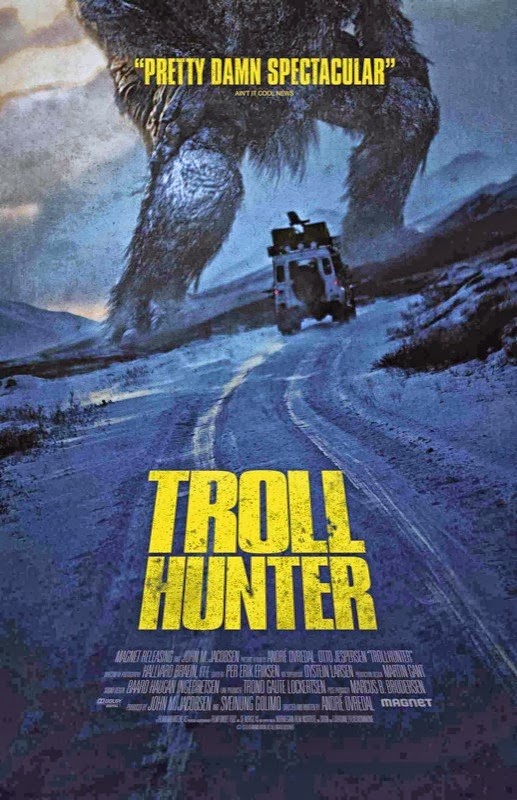
31 Days of Horror: Trollhunter (2010)

Director:  André Øvredal

Writer:  André Øvredal

Starring: Otto Jespersen, Hans Morten Hansen, Tomas Alf Larsen, Johanna Mørck, Knut Nærum, Robert Stoltenberg, Glenn Erland Tosterud

Summary: Trollhunter follows a group of Norwegian film students who are shadowing Hans, a professional hunter who tracks down and eliminates real-life trolls for the government agency known as the Troll Security Service, who do everything they can to keep the public ignorant of the troll menace.

The Good: As I've mentioned before, I am really not a fan of the "found footage" genre. Like 3-D, I see "found footage" as a gimmick that filmmakers use to make something seem more "real" when the actual style adds very little to the film. Thankfully, Trollhunter's director knows how to use the vérité and uses it well. Like The Bay, Trollhunter is shot as if its a documentary, which gives a ready explanation for the camera's presence. Also, since the documentary crew is supposed to be a couple of college students who have never made a documentary before, the questionable cinematography can be forgiven. 

The basic concept that acts as the foundation of the film is really interesting. While its not a very original premise, its still fun to see what it would be like if trolls actually existed. Being someone who loves folklore and mythology, it was cool to see the trolls retain their weakness to sunlight, their rock-based appetite, and the ability to smell the blood of a Christian. Its also interesting to learn how the trollhunter Hans hunts these creatures and learn how the Troll Security Service (TSS for short) keeps their existence a secret. After watching the film, I want to know more about these trolls, the TSS, and if similar organizations and other trollhunters exist around the world. 

Speaking of trollhunters, the character of Hans is rather intriguing as well. The character comes off as a weary warrior who is growing tired of the fight and sees the chance to finally come clean about the secrets he's been keeping when these college students who up, wanting to film him. Otter Jespersen plays the character perfectly, the tired nature of the character coming through clearly thanks to Jespersen's performance and posture throughout the film. He is easily the best thing in this film.

The Bad: While this is probably the result of a low budget, the CGI effects in the film are rather poor. They aren't horrible and they get the job done, but I always felt myself draw out of the film almost every time one of the trolls was on screen. The only exception was the Jotnar at the end of the film, which was pretty well done.

Besides Hans, the other characters in the film are rather bland or one-note. When Hans wasn't the focus of the film, I found myself not really caring about any of the other characters and just wanting to get back to Hans and his situation.

Conclusion: While the CGI is rather lackluster and most of the characters are rather bland, Trollhunters is saved by an interesting concept, good execution, and a very interesting main character. If you like monster movies and want to see one with an interesting take on the situation, give Trollhunter a watch.

Wednesday, July 31, 2013

Netflix Reviews: The ABCs of Death

Directed By: Nacho Vigalondo, Ti West, Adam Wingard, Srdjan Spasojevic, Ben Wheatly, Jon Schnepp, Xavier Gens, Jason Eisener, Yoshihiro Nishimura, etc.

Written By: Nacho Vigalondo, Ti West, Adam Wingard, Srdjan Spasojevic, Ben Wheatly, Jon Schnepp, Xavier Gens, Jason Eisener, Yoshihiro Nishimura, etc.

Main Cast: Dallas Malloy, Peter Pedrero, Fraser Corbett, Kyra Zagorsky, Darenzia, etc.

Summary: The ABCs of Death is an anthology film divided into 26 individual chapters, each handled by a different director assigned a different letter of the alphabet. Each director was given free rein to choose a word to create a story involving death, which range from accidents to murder.

The Good: Its kind of hard to review a film like The ABCs of Death. Not only is it an anthology film, but its an anthology film where each short is made by a different director and creative team and there are 26 of them. So, to make this easier on everyone reading, I'm just going to touch on the shorts I particularly liked and disliked.

G is for Gravity (directed and written by Andrew Traucki): This was the first short in the film that I actually liked. It was rather simple, short, and made good use of the letter G. While I'm not a big fan of the shaky cam, I can forgive it for this short since its supposed to be a first person perspective. I also loved how the short managed to convey its story without a single line of dialogue. The behavior and the heavy breathing of the POV character helped as well.

H is for Hydro-Electric Diffusion (directed and written by Thomas Malling): Malling's short was definitely one of the more comedic ones and one of the few of that variety that I actually felt worked. The short is just so weird, but you can feel the hard work the director and crew put into it and its easily one of the most fun. Also, the costuming, make-up, and set design was fantastic.

Q is for Quack (directed and written by Adam Wingard and Simon Barrett): Q is for Quack is another one of the "comedy" shorts that really works. I love the meta-fictional concept of the directors struggling to find a word and hook for the letter Q. The acting on this one is really solid as well, Wingard and Barret feeling very natural and believable as themselves. To be honest, this was probably my favorite short in the film.

U is for Unearthed (directed and written by Ben Wheatley): Another short shot with a first-person perspective, U is for Unearthed is a very quick and interesting little chapter. The film is shown from the perspective of a recently risen vampire who is chased by an angry mob that is trying to kill him. I think I liked this one mostly because it kept closer to vampiric mythology and kept the vampire as a soulless monster.

The Bad: Now, like most anthology films, The ABCs of Death is very uneven. While some of the shorts are really good and a lot of them are decent, there are some that are just god awful. Here's the ones that I personally found rather dreadful.

D is for Dogfight (directed and written by Marcel Sarmiento): While the cinematography is amazing and the use of slow-motion throughout the short is very effective, the are some big problems with the plot that when you start to think about them, make the story kind of fall apart.

F is for Fart (directed and written by Noboru Iguchi): This one was by far the dumbest short of the bunch. The story revolves around a Japanese school girl who decided she'd rather be killed by the teacher who she has a crush on's farts instead of a poisonous gas released by an earthquake. The special effects are horrible, the story is mind-numbingly dumb, and just had me shaking my head by the end of it.

M is for Miscarriage (directed and written by Ti West): This one was really disappointing because I usually like West's work. I loved House of the Devil and I thought The Innkeepers was fantastic. However, M is for Miscarriage is just really lazily done and rather mean-spirited. The only good thing about this chapter is that it is incredibly short.

O is for Orgasm (directed and written by Bruno Forzani & Helene Cattet): While I hate to use this word because it is incredibly overused, but its best word to use when critiquing this chapter. O is for Orgasm is just a collection of "artsy", pretentious images strung together. Luckily, like M is for Miscarriage, this one goes by rather quickly.

W is for WTF! (directed and written by Jon Schnepp): Like M is for Miscarriage, W is for WTF! is incredibly lazy and tries to steal the basic concept behind Q is for Quack. While the random nature of the short does match the chosen word pretty well, the random scenes aren't particularly good and are downright annoying at times.

Conclusion: As with most anthology films, The ABCs of Death is very uneven. Some of the shorts really work and are interesting, some are decent but kind of forgettable or don't really stand out all that much, and some are just terrible and bring the film down. Basically, the film is a very mixed bag.

Recommended?: Yes and no. While I wouldn't recommend it to a general audience, I would say check it out if you like to watch strange movies, are a fan of some of the directors, and have a few friends over who you can laugh at it with and see how they react. Otherwise, you can skip The ABCs of Death.

Thursday, May 9, 2013

Book Review: A Princess of Mars

A Princess of Mars, which originated as a series of short stories written by Edgar Rice Burroughs, tells the tale of Confederate veteran John Carter. While he is prospecting in the wilds of Arizona, Carter is mysteriously transported to the dying world of Mars (known as "Barsoom" by its inhabitants). Thanks to the planet's lesser gravity, Carter discovers he has great strength and superhuman agility. As he travels across the deserts of Mars, he comes into contact with a race of giant humanoids with green skin and six limbs known as "Tharks", the beautiful princess of the Martian city of Helium named Dejah Thoris, and finds himself embroiled in a war that threatens to tear two city-states apart.

While John Carter's popularity and notoriety has diminished over the years, A Princess of Mars and its sequels are considered classic examples of 20th century pulp fiction. The "Barsoom" series inspired a number of well-known science fiction writers, such as Jack Vance, Ray Bradbury, Arthur C. Clarke, Robert A. Heinlein, and John Norman. The series also inspired a number of scientists in the fields of space exploration and the search for extraterrestrial life, including Carl Sagan, who read A Princess of Mars when he was just a child. While A Princess of Mars is an incredibly influential work that has touched many readers over the decades, there are two questions that need to be asked.

Is A Princess of Mars actually good and does it deserve the praise heaped upon it?

From a writing stand point, A Princess of Mars has a few problems. First, there are a lot of scenes in the book that are simply glossed over and have the action take place "off screen". While this is annoying from a reader's stand point since I firmly believe in the "show, don't tell" school of writing, these scenes are probably a result of how these stories were originally presented and the fact that Burroughs most likely had both a time and word limit.

Secondly, the way the narrative is structure presents some problems as well. A Princess of Mars is presented a collection of memoirs written by Carter. Because Carter is our only narrator, we occasionally receive a large exposition dump that can cause the pace of the story to slow down. However, I will admit the 1st person perspective works here because we, as outsiders, get to see the dying world of Mars through the eyes of an outsider. So, there is at least an excuse for the exposition dumps.

Even with the technical problems, I found myself really enjoying A Princess of Mars for its characters and the world that it presents. While he is not a very deep character, Carter is the type of pulp hero I can't help love. He's brave, a skilled combatant, a quick learner, and willing to do whatever it takes to save the people he cares about. There is just something rather refreshing about a hero that is so simple and straightforward.

However, if you want characters with layers, Burroughs gives you the Tharks named Tars Tarkas and Sola. Both characters were born into a brutal and violent society, but possess tragic histories and personality traits that separate them from the rest of the Tharks and make them some of the most interesting characters in the book.

The setting of Mars also kept me interesting and made me really wish I could explore Barsoom for myself. For reasons that escape me, the idea of Mars being a dying planet inhabited by such desperate societies who have developed airships and other wondrous technology fascinating. I can understand why so many people were inspired by it. Hell, this depiction of Mars makes me want to write my very own Martian stories.

A Princess of Mars is a book that has its fair share of technical problems, but I can see why people consider it a classic pulp fiction story and has inspired so many people. If you can get past the technical problems and just enjoy the setting and characters, you will enjoy A Princess of Mars.

Wednesday, May 8, 2013

Thoughts on Earth 2 #9-12

As I've mentioned before, Earth 2 is easily one of my favorite comic books DC is publishing at the moment. Robinson knows how to breathe new life into these Golden Age characters while staying true to the history associated with them. Also, Earth 2 shows you can have stories that are both dramatic and fun to read.

After the defeat of Solomon Grundy and the re-introduction of Steppenwolf, the last four issues (#9 - #12) have dealt with the re-introduction of Dr. Fate and seeing the characters come together in the end. Seeing as Dr. Fate is one of my favorite characters in the DC Universe and the Justice Society is one of my favorite teams, you can understand why I was excited for the "Tower of Fate" storyline.

Thankfully, Robinson did not disappoint me. "Tower of Fate" is a well-written story arc that does a fantastic job of introducing the new characters of Fate, revealing the more supernatural and magical side of Earth 2, and telling a fun story that also helped push the meta-plot further along.

Each part of the story did what I want every issue of a comic book to do: further along the story without feeling incomplete. Each issue remains entertaining and feels satisfying while keeping you interested in the overall story. This is just another example of why Robinson is a talented writer.

Of the four issues, my favorite has to be #11. In the issue, we get to see why Jay Garrick is an awesome character. While he is faced with a situation that could possibly end in his demise, Garrick knows he can't give up and will sacrifice his life to protect the world and the ones he cares about. This dedication to what is right and the willingness to sacrifice oneself for that cause is what makes a character heroic. Knowing it's that heroic attitude that inspires Khalid Ben-Hassin to finally put on the Helmet of Nabu and become Dr. Fate, even thought it might cost him his sanity.

The only real weakness present in these four issues is the same weakness that I mentioned back in my review of #8. While Robinson is a talented writer, his tendency to over-explain and not let the illustrations tell the story at times can get a little annoying. However, that weakness is less noticeable in these four issues, which is great.

If you love fun superhero stories with a heavy dose of magic and the supernatural, I would recommend you give Earth 2 #9 - #12 a read. You will not be disappointed.

Tuesday, May 7, 2013

Netflix Reviews: John Dies at the End

Based on the book by Jason Pargin (under the pseudonym David Wong), John Dies at the End tells the story of two down on their luck college drop-outs named John and David. After purposefully and accidentally partaking in a strange, new drug known as "soy sauce" that promises to send the two on a trip that transcends time and space, John and David find themselves dealing with a dimensional invasion that threatens the entire world.

John Dies at the End, for one reason or another, reminds me of John Carpenter's awesomely bizarre Big Trouble in Little China. Both films manage to blend bizarre visuals and story twists, well-written humor, and chaotic awesomeness together into a strange, little mixture that some audiences will love and others will hate or find confusing. Luckily, I happen to fall into the former group.

John Dies at the End is a perfect example of why Don Coscarelli (Bubba Ho-Tep, Phantasm) has such a cult following. Coscarelli is incredibly deft at taking the bizarre, the horrific, and the comedic and mixing them together into a single entity that is both well-crafted and entertaining. While the genre-bending construct that is John Dies at the End might not appeal everyone, those who just sit back and let the weirdness wash over them and draw them in will most likely find something to love and enjoy.

The acting is equally superb. Both Chase Williamson (David) and Rob Mayes (John) play their parts perfectly, feeling just like normal guys who have been dropped into a situation way over their heads and adapting to it as best as they can. Clancy Brown and Paul Giamatti are as good as always and manage to make both of their characters memorable despite only having a few scenes in the movie.

The only major flaw in my opinion is that some of the CGI effects are rather cheesy and bad, especially in comparison to the well-done practical effects. However, I wonder if the shoddiness of the CGI is due to the film's low budget or a conscious decision on Coscarelli's part to add to the cheesiness of the film.

John Dies at the End is an incredibly enjoyable, bizarre film that will please audiences that found films like Big Trouble in Little China and The Adventures of Buckaroo Banzai Across the 8th Dimension enjoyable. However, the bizarre and chaotic nature of the film could possibly be a deal-breaker with some. If you like a good dose of weirdness and dark comedy with your horror, I suggest giving John Dies at the End a chance. 

Sunday, April 21, 2013

Book Review: Summer Knight

Written by Jim Butcher, The Dresden Files is a series of fourteen fantasy/mystery novels starring the private investigator and wizard Harry Dresden. Each novel is told from a first person perspective where Dresden recounts one of his investigations into supernatural disturbances in modern-day Chicago.

Summer Knight is the 4th book in the series and takes place two years after the events in the 1st book Storm Front. After loosing the person closest to him, Dresden just hasn't been himself. He's having trouble paying the rent, alienating his friends, and not taking very good care of himself.

Just when it seems like things couldn't get any worse, the only professional wizard in the phone book is approached by the Winter Queen of Faerie and she has an offer that Harry just can't refuse. She wants him to figure out who murdered the Summer Queen's right hand man, the Summer Knight, and clear the Winter Queen's name. However, Harry should know by now nothing is as it seems, especially when fairies are involved.

To be perfectly honest, Summer Knight left me with rather mixed emotions. On one hand, Butcher's writing remains top-notch. Like the three previous entries in the series, Butcher knows how to bring each character to life and make them pop off the page, even if they are just a secondary character who only shows up once or twice.

Butcher also does a fantastic job at introducing the new details surrounding the Faerie Courts of the Nevernever. Some of my favorite elements in the book were the details about fey culture, the hierarchy of the Summer and Winter Courts, and the political intrigue and power struggles happening between them. As someone who enjoys building and crafting their own fantastical worlds, it's always entertaining for me to read these details about the world.

However, the book isn't flawless. Like the other books in the series so far, there is a large dump of information near the end of the book to make sure everyone knows what is actually happening feels kind of clunky in its execution.

The biggest problem I had with Summer Knight is the somewhat messy nature of the narrative. While on paper the plot makes sense and I was still satisfied with the book overall, I felt the book's plotting could have been a lot tighter.

With that being said, Summer Knight is still an entertaining book in an entertaining series. If you are a fan of The Dresden Files and "Urban Fantasy" stories in general, I suggest giving Summer Knight a read. However, you might be lost if you haven't read the three previous books (Storm Front, Fool Moon, and Grave Peril).